
Introduction
AI tools are becoming incredibly powerful in 2026.
But most people still use them the wrong way.
They write:
- One massive prompt
- Expect perfect output
- Then wonder why the results are inconsistent
The problem is not the AI.
- The problem is the workflow.
That’s where prompt chaining comes in.
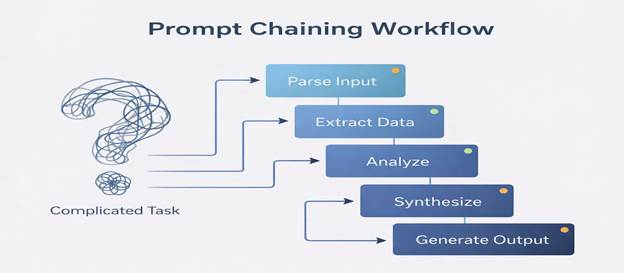
Instead of trying to solve everything in one prompt, prompt chaining breaks complex tasks into smaller, reusable steps.
Think of it like this:
❌ One giant instruction
✅ Multiple connected prompts working together
This approach is transforming:
- AI-assisted development
- Content creation
- Automation workflows
- Research systems
- Product design
What is Prompt Chaining?
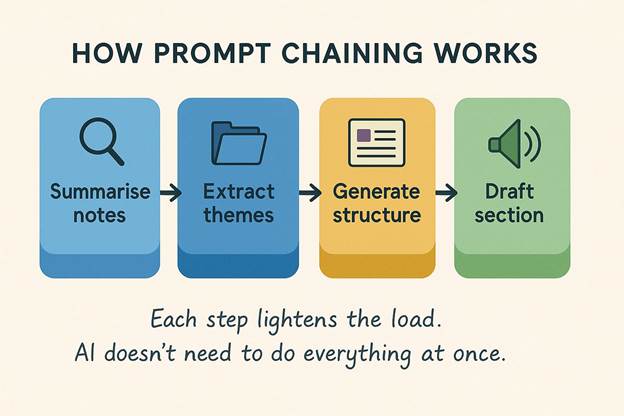
Prompt chaining is the process of connecting multiple prompts together so the output of one step becomes the input for the next.
Instead of asking AI to do everything at once, you guide it through a structured workflow.
Simple Example
Instead of saying:
“Create a startup business plan”
You split it into stages:
- Generate startup ideas
- Select the best idea
- Create target audience profile
- Generate business model
- Create marketing strategy
- Each prompt handles one clear task.
This produces:
- Better accuracy
- More control
- Reusable systems
Why Single Prompts Fail
Large prompts often create:
- Confusing outputs
- Missed instructions
- Inconsistent formatting
- AI hallucinations
Why?
Because complex problems contain multiple sub-problems.
AI performs better when:
✅ Instructions are focused
✅ Tasks are separated
✅ Context is controlled
The Core Idea Behind Prompt Systems
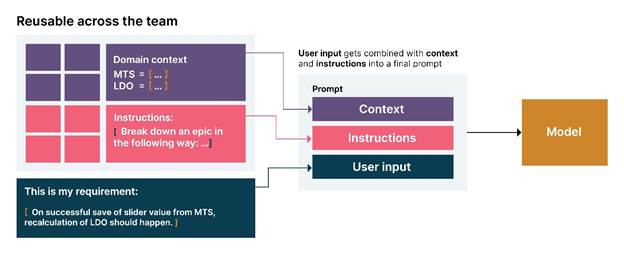
A prompt system is a reusable sequence of prompts designed to solve a repeatable workflow.
Instead of rewriting prompts every time, you build a structured process.
Example Prompt System for Blog Writing
Step 1: Generate blog topic ideas
Prompt:
“Generate 10 AI blog topics for developers.”
Step 2: Select best topic
Prompt:
“Choose the topic with highest SEO potential.”
Step 3: Create outline
Prompt:
“Create an SEO-friendly blog outline.”
Step 4: Write sections
Prompt:
“Write the introduction in a professional tone.”
- This becomes a reusable content workflow.
Prompt Chaining vs Traditional Prompting
| Traditional Prompting | Prompt Chaining |
| One large instruction | Multiple smaller prompts |
| Less control | High control |
| Hard to debug | Easy to improve |
| Inconsistent outputs | Structured outputs |
| Difficult to scale | Reusable systems |
How Prompt Chaining Works
Most prompt chains follow this structure:
Step 1: Input Prompt
Define the goal
Step 2: Processing Prompt
Break down the task
Step 3: Refinement Prompt
Improve the output
Step 4: Finalization Prompt
Format or optimize results
Example Workflow
Goal:
Create a landing page
Prompt Chain:
- Generate page structure
- Write headline options
- Generate CTA text
- Create feature descriptions
- Improve readability
- Each step improves the next.
Why Prompt Chaining Matters in 2026
AI is shifting from:
- Single interactions
To
- Structured AI workflows
The best AI users today are not:
- Writing better single prompts
They are:
- Building better systems
Reusable Prompt Systems
The real power of prompt chaining is reusability.
Once you create a workflow, you can reuse it for:
- Content generation
- Coding
- Marketing
- Product planning
- Research automation
Example: AI Coding Workflow
Prompt 1:
“Break this app idea into components.”
Prompt 2:
“Generate backend architecture.”
Prompt 3:
“Generate frontend UI structure.”
Prompt 4:
“Create API endpoints.”
Prompt 5:
“Optimize scalability.”
- This becomes a repeatable development pipeline.
Common Mistakes in Prompt Chaining
❌ Making prompts too vague
AI needs specificity
❌ Skipping intermediate steps
Leads to weak outputs
❌ Overcomplicating chains
Too many prompts reduce efficiency
❌ No refinement stage
Raw output is rarely perfect
Best Practices for Effective Prompt Chains
✅ Keep prompts modular
Each prompt should solve one problem
✅ Maintain context consistency
Use structured outputs
✅ Reuse templates
Turn good workflows into systems
✅ Iterate continuously
Improve chains over time
Future of Prompt Engineering
Prompt engineering is evolving into:
- Workflow engineering
- AI orchestration
- System-level thinking
The future is not:
❌ “Who writes the smartest prompt?”
It’s:
✅ “Who builds the smartest AI systems?”

Prompt Chaining + AI Agents
Modern AI agents already use prompt chaining internally.
They:
- Plan tasks
- Break down problems
- Execute sequential actions
- Refine outputs automatically
Prompt chaining is becoming the foundation of autonomous AI systems.
Final Verdict
Prompt chaining changes how you work with AI.
Instead of:
❌ Hoping for perfect outputs
You:
✅ Build repeatable systems
Want to Apply Prompt Chaining in Real Projects?
At Semat Technologies’ hands-on AI Coding Workshop in Pune, you’ll learn how to:
- Build structured AI workflows
- Create reusable prompt systems
- Use AI tools effectively for development
- Move from idea → prompt → production-ready apps
Workshop Details:
👉 https://semat.in/vibe-coding-workshop/
Conclusion
The future of AI is not about single prompts.
It’s about:
- Structured workflows
- Reusable systems
- Intelligent orchestration
In 2026, the people getting the best results from AI are not the ones asking better questions once.
They’re the ones building systems that solve problems repeatedly.