
Last week, during a session I was running on Advanced GenAI Solutions, someone raised their hand and asked a question I’ve heard more times than I can count: “Why would we use Bedrock instead of just calling Anthropic directly?”
It’s a fair question. And it’s one my team and I had to answer for real on a recent project — not as a whiteboard exercise, but as an actual architecture decision with real trade-offs attached. So I figured it was worth writing up properly, for anyone else who’s about to have this same conversation with their engineering team, their security folks, or their leadership.
Let’s start with the thing that trips people up first.
Same Model, Different Everything Else
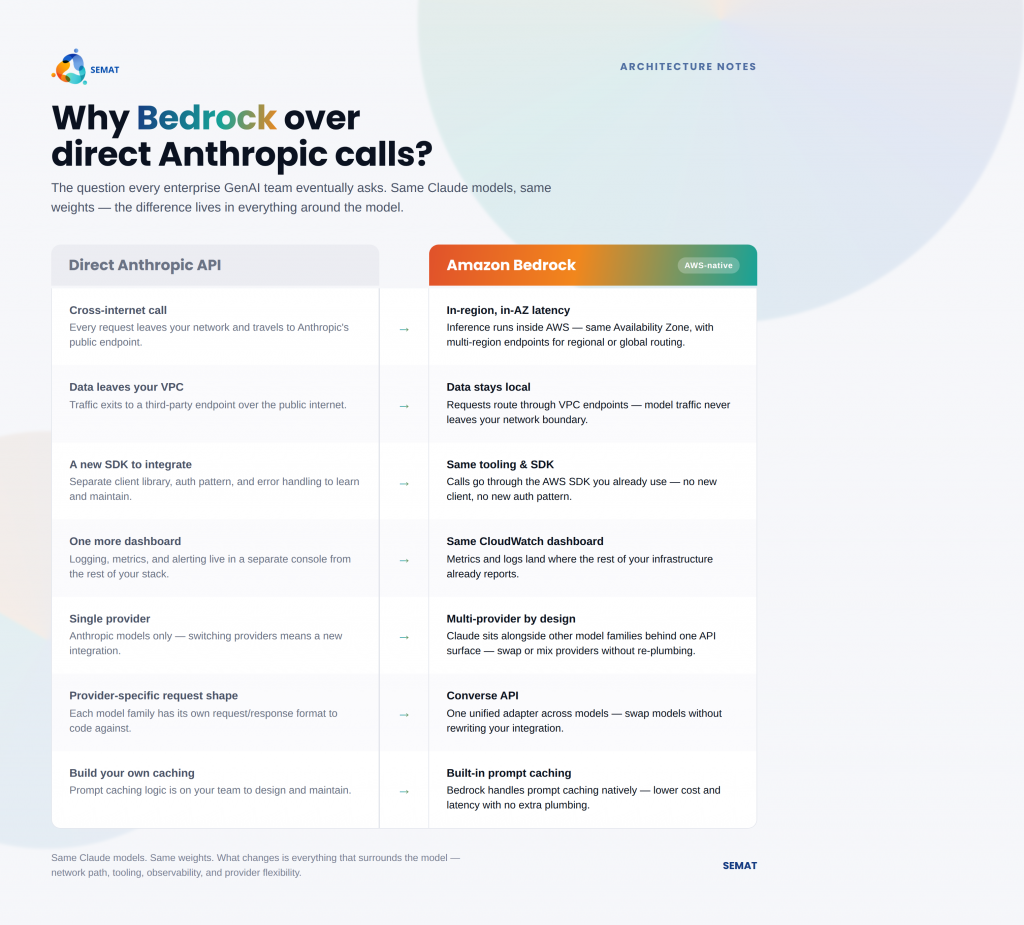
Here’s the part that surprises people: whether you call Claude through Amazon Bedrock or straight through Anthropic’s own API, you’re getting the exact same model. Same weights, same capabilities, same quality of output for the same prompt. This isn’t a “which one is smarter” decision — anyone telling you otherwise is selling something.
What actually changes is everything around the model: how the request gets there, where your data travels, what tooling you use to manage it, and how it fits into the rest of your stack. That’s the real decision. And once you frame it that way, the answer usually becomes pretty clear for your specific situation.
So let’s walk through the differences that actually matter in practice — the same ones I put together for my team.
1. Latency: Staying Inside the Neighborhood
When you call Anthropic’s API directly, your request leaves your network, travels across the public internet, and lands on Anthropic’s endpoint. It’s fast, but it’s still a cross-internet hop.
With Bedrock, inference runs inside AWS — often in the same Availability Zone as the rest of your application. And if you’re operating across regions, Bedrock gives you multi-region endpoint support, so you can route traffic to whichever region makes sense, regionally or globally, without re-architecting anything.
If your application is latency-sensitive — think real-time chat, voice, or anything in a tight user-facing loop — this alone can be worth the conversation.
2. Data Stays Local
This is usually the one that gets security teams nodding along. With Bedrock, requests route through VPC endpoints, which means your data never has to leave your network boundary to reach the model. It stays inside your AWS environment the whole way through.
With the direct API, your data is making a trip out to a third-party endpoint over the public internet. Anthropic takes data security seriously and offers strong protections of its own — but for teams operating under strict data residency or network isolation requirements, “it never leaves the VPC” is a much easier sentence to put in front of a compliance review.
3. Same Tooling, Same SDK
If you’re already building on AWS, you already have the AWS SDK, the auth patterns, the IAM roles — all of it. Bedrock plugs Claude into that exact same tooling. No new client library to learn, no separate authentication flow to build and maintain, no additional dependency for your team to own.
Going direct to Anthropic means bringing in a new SDK, a new auth pattern, and new error handling conventions. Not a dealbreaker by any means — Anthropic’s SDKs are genuinely well designed — but it is one more thing your team has to integrate, document, and keep patched.
4. One Dashboard, Not Two
Nobody wants another tab open. If your team already lives in CloudWatch for logging, metrics, and alerting, Bedrock keeps everything there. Your Claude calls show up right alongside the rest of your infrastructure’s telemetry — no separate console to check, no second place to configure alerts.
With a direct integration, you’re standing up observability for a completely separate service, which usually means yet another dashboard your on-call engineer has to remember exists at 2 a.m.
5. Multi-Provider Flexibility
This is a bigger strategic point than it looks at first glance. Go direct to Anthropic, and you’re integrated with exactly one provider. If you ever want to add another model into the mix — for cost reasons, redundancy, or just to test something new — that’s a brand-new integration from scratch.
Bedrock puts Claude behind the same API surface as other model providers. That means you can swap models, run multiple providers side by side, or mix and match for different workloads, without re-plumbing your entire application every time.
6. The Converse API
Related to the point above: different model providers structure their requests and responses differently. If you’re calling multiple providers directly, you end up writing (and maintaining) provider-specific glue code for each one.
Bedrock’s Converse API gives you one unified way to talk to models, regardless of which provider is behind them. Swap Claude for another model, and your integration code barely has to change. That’s a meaningful reduction in long-term maintenance burden if you’re building anything that might need model flexibility down the line.
7. Prompt Caching, Built In
Prompt caching can meaningfully cut both cost and latency for workloads with repeated context — think long system prompts, RAG pipelines, or multi-turn conversations. Bedrock handles this natively. You don’t have to design or maintain your own caching layer; it’s just there.
If you go direct, you’re on the hook for building that yourself (or living without it).
So… Which Should You Choose?
Here’s my honest, field-tested take: if your workload is a fairly standard inference call and you’re already standardized on AWS for identity, networking, and observability, Bedrock is the boring, defensible default. It removes a lot of operational overhead your team would otherwise have to own.
If you need Anthropic’s newest capabilities the moment they ship — new models, new features — going direct usually gets you there first, since Bedrock typically trails by some weeks. And if you’re not an AWS shop at all, the simplicity of a single vendor relationship might just win outright.
There isn’t a universally “correct” answer here. But there is a correct process: understand what actually changes between the two paths, match it against what your team and your compliance requirements actually need, and make the call deliberately — instead of defaulting to whichever one you heard about first.
That’s exactly the conversation I had with my team on our project, and it’s the one I ended up having again in that session last week. Hopefully this write-up saves you from having to reconstruct it from scratch.
Have you run into this decision on your own projects? I’d love to hear what tipped the scale for you — drop a comment or reach out.