
Introduction
AI tools are becoming smarter, faster, and more capable in 2026.
But there’s still one major problem developers, researchers, and businesses struggle with:
- AI hallucinations.
Sometimes AI:
- Generates incorrect information
- Makes up facts confidently
- Produces flawed reasoning
- Gives unreliable answers
This becomes dangerous in:
- Software development
- Research
- Healthcare
- Finance
- Customer support
That’s why modern AI workflows are moving toward structured reasoning techniques like:
✅ Chain-of-Thought (CoT)
✅ ReAct (Reason + Act)
These methods dramatically improve reliability by making AI “think” step-by-step instead of jumping directly to conclusions.
What Are AI Hallucinations?
AI hallucinations occur when an AI model generates:
- False information
- Incorrect assumptions
- Fabricated details
Even when the response sounds convincing.
Example
Prompt:
“Explain a scientific paper that doesn’t exist.”
AI might:
❌ Invent fake authors
❌ Create fake citations
❌ Fabricate research findings
The problem is not always intelligence.
- The problem is uncontrolled reasoning.

Why Hallucinations Happen
AI models predict the most likely next word based on patterns.
They do not inherently:
- Verify truth
- Understand reality
- Fact-check outputs
Without structured reasoning, AI may:
- Skip logical steps
- Assume missing information
- Produce overconfident answers
This is why prompting techniques matter.
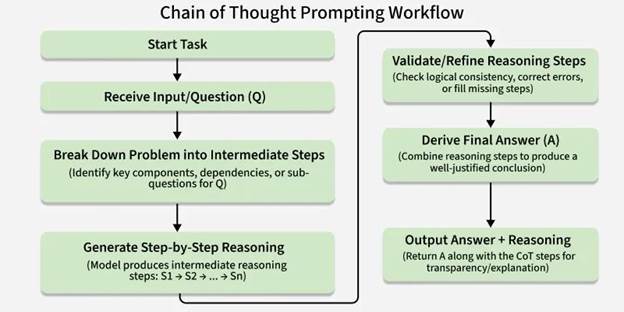
What is Chain-of-Thought (CoT) Prompting?
Chain-of-Thought (CoT) prompting encourages AI to reason step-by-step before generating a final answer.
Instead of:
❌ Direct answer generation
AI performs:
✅ Intermediate reasoning
Example Without CoT
Prompt:
“If a train travels 60 km in 1 hour, how far in 3 hours?”
AI may answer correctly.
But for more complex tasks, errors increase.
Example With CoT
Prompt:
“Think step-by-step. If a train travels 60 km in 1 hour, how far in 3 hours?”
AI reasoning:
- Speed = 60 km/hour
- Time = 3 hours
- Distance = speed × time
- Distance = 180 km
✅ More reliable reasoning.
Benefits of Chain-of-Thought Prompting
CoT improves:
- Logical reasoning
- Mathematical accuracy
- Multi-step problem solving
- Decision transparency
It also helps users:
✅ Understand how AI reached conclusions
✅ Detect errors more easily
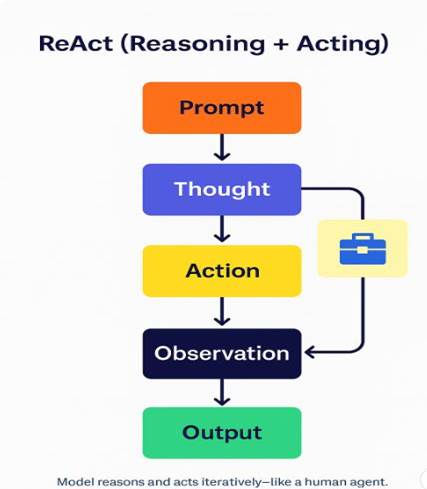
What is ReAct Prompting?
ReAct stands for:
👉 Reason + Act
It combines:
- Step-by-step reasoning
- External actions/tools
Instead of only “thinking,” AI can:
- Search for information
- Retrieve context
- Use tools
- Validate outputs
ReAct Workflow
- Reason about the problem
- Take an action
- Observe results
- Continue reasoning
This creates more grounded responses.
Example of ReAct Prompting
User Query:
“What’s the current weather in Tokyo and how should I dress?”
ReAct Process:
Reason:
Need current weather information.
Action:
Retrieve weather data.
Observation:
15°C and rainy.
Final Response:
“Wear a light jacket and carry an umbrella.”
👉 AI becomes more accurate because it interacts with real information.
ReAct vs Chain-of-Thought
| Chain-of-Thought | ReAct |
| Internal reasoning | Reasoning + external actions |
| Step-by-step logic | Interactive workflows |
| Better for analysis | Better for real-world tasks |
| No tool usage | Uses tools and retrieval |
Why These Methods Matter in 2026
AI is increasingly used in:
- Coding assistants
- Autonomous agents
- Customer support systems
- Enterprise automation
Hallucinations in these systems can:
❌ Break workflows
❌ Create misinformation
❌ Reduce trust
That’s why structured reasoning is becoming essential.
Using CoT and ReAct in AI Development
Developers now design prompts like:
CoT Example
“Break the problem into logical steps before answering.”
ReAct Example
“Search documentation before generating code.”
These methods:
- Improve consistency
- Reduce hallucinations
- Create reliable AI workflows
Best Practices to Reduce Hallucinations
✅ Use step-by-step prompting
Avoid vague prompts
✅ Ask AI to explain reasoning
Improves transparency
✅ Use retrieval systems
Ground outputs in real data
✅ Validate outputs
Never trust AI blindly
✅ Break large tasks into smaller workflows
Improves reliability
Future of Reliable AI Systems
The future of AI is not just:
❌ Bigger models
It’s:
✅ Better reasoning systems
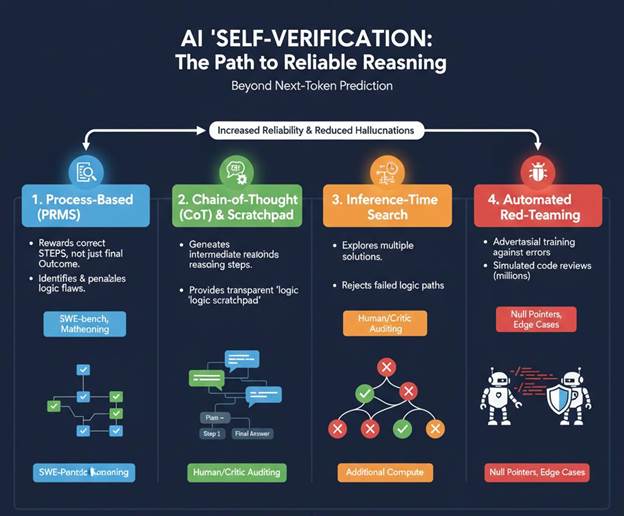
Modern AI development is moving toward:
- Agentic workflows
- Retrieval-augmented generation (RAG)
- Multi-step reasoning
- Self-verification systems
Reliability is becoming more important than raw generation speed.
Final Verdict
AI hallucinations are not going away automatically.
The solution is:
👉 Structured reasoning.
Techniques like:
- Chain-of-Thought (CoT)
- ReAct prompting
help AI:
✅ Think better
✅ Verify information
✅ Produce more reliable outputs
Conclusion
As AI becomes integrated into critical workflows, reliability becomes essential.
The future belongs to AI systems that:
- Reason clearly
- Verify intelligently
- Operate transparently
🚀 In 2026, successful AI workflows are no longer just about generating responses.
They’re about generating trustworthy responses.
Want to Learn Reliable AI Development Workflows?
Join our hands-on AI Coding Workshop in Pune where you’ll learn:
- AI-assisted development workflows
- Prompt engineering techniques
- Structured reasoning systems
- AI debugging and deployment workflows
- Building scalable AI-powered applications
🚀 Workshop Link:
👉 VibeCodingWorkshop
Related Blogs
- Prompt Chaining 101: How to Break Complex Problems into Reusable Prompt Systems
- The “Idea → PRD → Build” Loop: How to Master the AI-Assisted Development Workflow
- Building Full-Stack Apps with Natural Language: Why System Design Beats Syntax in 2026
- Vibe Coding vs. Low-Code: Is Traditional Syntax Knowledge Becoming Irrelevant in 2026?